Starting your lawn quest
Turfing your property is an investment. It’s generally the last piece of the landscaping puzzle and can have the largest effect overall. To see dirt turn to lawn is just amazing! There is no doubting the impact. Keeping the lawn thriving throughout the years can be trickier but is still easily achievable. A perpetually healthy lush thick lawn starts with the right advice in the planning stages and that’s why we have designed our 10-step guide to discovering your ideal turf type.
Your lawn will be the most used element of landscaping at your home from backyard playtime, outdoor parties, and BBQs, to just plain relaxing on a South-East Queensland afternoon. So, making a great choice in the right turf for you is most definitely a good investment and worth the ultimate lawn search. Every customer has a different set of criteria that we consider before we recommend the ideal variety for them.
What is turf?
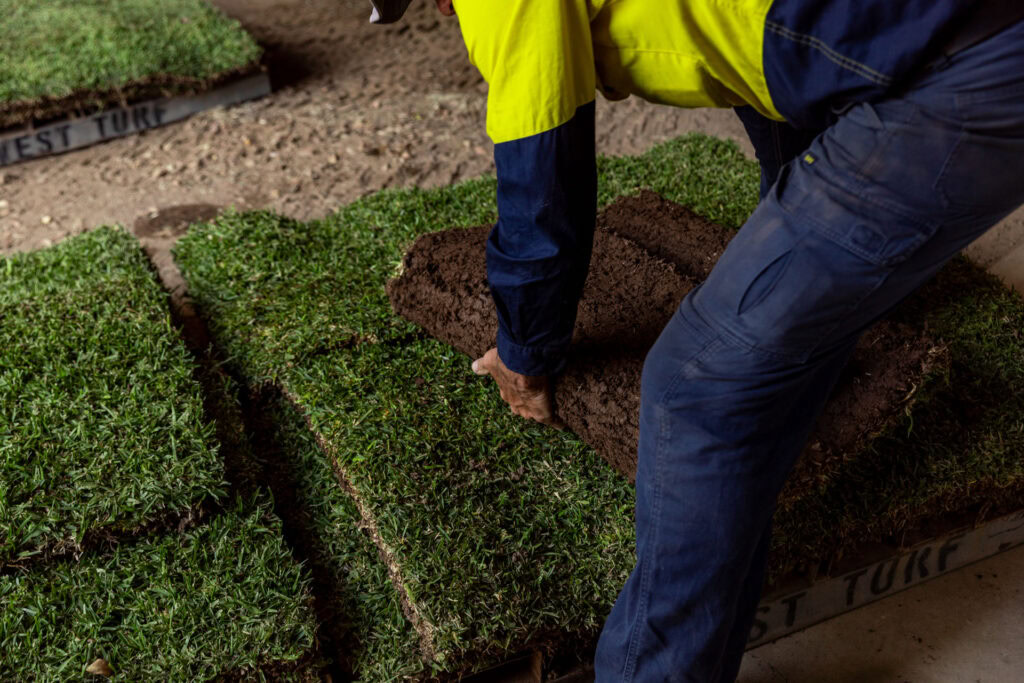
Technically, turf is the grass, roots, and the soil the roots are in. It is the top layer of a grassed area. It can be cut, removed, and replaced – like in a backyard; or harvested into slabs or rolls in the case of a turf farm. At West Turf we have large harvesters that cut the turf into slabs 600mm x 1200mm and automatically stack the slabs onto pallets for transport. Each wintergreen slab holds approximately 25mm of soil and roots with the leaf on top.
There are three types of grass you can install at your home:
- Instant turf slabs or rolls. This is the fastest way to achieve a new lawn. Instant turf is available in many different varieties and is easy to install. Instant turf is already a mature plant harvested from a farm, so it is therefore quick to “take” and is free of weeds. Just like buying a plant from a nursery, you need to water it for two to four weeks until it establishes, then you can use it and take care of it with routine maintenance.
- Seed. Some varieties of turf are available in seed form. Planting lawn from seed is about 10% the cost of instant lawn, but requires more patience, water, and an extra sow of seed may be necessary. Weeds will grow while the lawn establishes. At West Turf we frequently take orders from people who have tried this option and given up!
- Artificial. This is fake grass – synthetic grass on a layer of rubber and plastic. People often install it believing it to be a low maintenance option, but it requires frequent washing, brushing, and sanitising because nothing breaks down on it – dog poo, leaf matter, etc. Fake grass also makes an area much hotter than natural/real grass.
When choosing what type of grass to install, instant turf wins every time – fast, easy, natural, and environmentally friendly!
Understanding Turf Varieties
Here’s a crash course in turf facts that will benefit first-time lawn installers.
Grass Types
Common grass types fit into two categories: warm season and cool season. Warm season grasses thrive in warmer climates while cool season grasses thrive in cool climates. But South-East Queensland never really gets cold! So, for yards in Ipswich, Logan, Brisbane, Redlands, Moreton Bay and the Gold and Sunshine Coasts, in fact everywhere in Queensland, the turf type suited to your area is warm season grasses.
Grass Varieties
Warm climate grass varieties perfect for South-East Queensland are: Couch, Kikuyu, Buffalo, and Zoysia grasses. These varieties will mostly thrive on rainfall and a weekly water once properly established. They may lose a little colour and will go dormant over the winter months but will quickly revive during spring. West Turf stocks Zoysia, Sir Walter, Soft Leaf Buffalo, Aussiblue and Wintergreen Couch.
Shade or full sun
A major factor when choosing your ideal turf type if the number of sunlight hours the area will receive each day as well as the intensity of the sunlight. Map how the sun falls on your yard during the day. Remember it will be different in summer as it is in winter. Fences and neighbours’ houses are solid structures that block sunlight. Trees and shrubs generally let through dappled light and can be pruned to let through more. Not all varieties of turf are shade tolerant. See below West Turf’s varieties and their shade tolerance:
- Wintergreen Couch – needs 7 hours of sun or more per day
- Aussiblue Couch – needs 5 hours of sun or more per day
- Zoysia – needs 4 hours of sun or more per day
- Soft Leaf Buffalo, and Sir Walter Buffalo – need 3 hours of sun or more per day
Maintenance
Some people are complete lawn junkies. They manicure their lawns to the envy of the entire street and thoroughly enjoy every facet of lawn maintenance. Other people want easy, low maintenance grass that basically stays “green” with the least amount of effort. The fact is, all varieties will need a little love and attention to thrive. Fertilising once a season and a deep water once a week will generally suffice to keep your lawn green and lush, along with a regular mow. Here are the major maintenance issues to consider when conducting your ultimate turf search:
Drought tolerance and watering
Drought tolerance refers to the grass’s ability to withstand dry spells and bounce back once it does get water. At West Turf, our most drought tolerant varieties are Zoysia, Wintergreen and Aussiblue. Keep in mind, even the most drought tolerant turf varieties will need some water, or they will lose vigour and be thin and susceptible to weeds. To give your new lawn the best drought tolerance super-power:
- start with a good soil profile of 100mm for adequate soil water storage;
- use quality sandy loam underturf mix;
- add a lawn starter fertilister with water crystals on top of the underturf mix;
- once established, continue to water your lawn deeply but infrequently (once a week) to stimulate deeper growth in the root system.
Growth rate and mowing
Turf varieties grow at their own pace. At West Turf the growth rate of the varieties we stock are:
- Fast growth rate: Sir Walter, Aussiblue and Wintergreen
- Slow growth rate: Zoysia and Soft Leaf Buffalo.
During warmer months, depending on irrigation and rainfall, expect to mow Sir Walter, Wintergreen and Aussiblue once to twice a week, and Zoysia and Buffalo every 10 days to a fortnight. All varieties slow considerably in growth over winter months. How often you want to be pushing the mower should influence your ultimate turf search.
Wear tolerance
Think about the use of the space you want to turf. Will it be a play area for the kids, will the dog dig and run a track along the fence line, or will it be an area “just for show”? Some turf varieties cope very well with constant traffic and repair well if damaged, some don’t. Even if a variety has high wear tolerance, it can be difficult to repair if growth is slow and it may be best to replace the affected section with new slabs. It is best to choose a variety that suits your yard’s use, while considering all other factors in the selection process.
Cost
The retail price of turf is set by the cost and time it takes to grow each variety to point of sale. For instance, Wintergreen will be harvested twice a year, whereas Zoysia is harvested only once a year. Everyone is budget conscious these days. As a small, family turf farming operation, we keep our retail prices low at West Turf. We have turf varieties for all budgets…check out our price list.
Look and feel
Once you have determined your contributing factors, consider which turf variety you like the look of most. Use the West Turf website to get a run down on each variety’s specific attributes.

Your 10-Step Guide to Discovering Your Ideal Turf Type
With that said, we have provided ten simple steps to consider in your search for the ultimate instant lawn.
Step 1: Get to know your soil conditions.
If you have poor soil, improve it. The best underturf preparation produces the ideal lawn in the long run. 100mmm of good quality sandy loam will allow adequate water storage in dry times and encourage a strong root system for your lawn.
Step 2: Weather matters – pick the right turf for your local climate.
South-East Queensland turf producers will only grow warm season grasses that are suitable for this region. Be confident West Turf is growing turf ideal for your yard. No matter what your considerations, we have a turf variety for you.
Step 3: Usage Patterns – different types of turf for different home lawns.
Consider how your space to be turfed will used. You may need to purchase a durable variety that can stand up to the fun and activity of the kids and family dog. On the other hand, you may be turfing a slope and need a slow growing variety that requires significantly less mowing.
Step 4: Low maintenance vs regular mowing – what’s your maintenance level?
Lifestyle is key these days. Think about the time you are willing to dedicate to maintaining your lawn. Some varieties require half the mowing commitment than others.
Step 5: Full sun or shade – finding your turf’s comfort zone.
How much shade your yard gets during the day is a major consideration in purchasing the ideal turf for your home. The positioning of your home, existing trees and shrubs, fences and structures affect the amount of sunlight on your area to be turfed. At West Turf we sell turf that can thrive on as little as three hours of sun per day.
Step 6: Quenching your turf’s thirst - drought tolerance and water requirements.
Newly laid turf has a limited root system and will dry out very quickly. Daily watering is a must until deeper roots have grown through the underturf soil. Buffalo varieties will require more water than couch and zoysia. Once your turf has established, encourage deep roots with infrequent, long soaks once a week.
Step 7: Beauty in the blades – aesthetics of grass varieties
If you have all the other boxes ticked – shade tolerance, usage, maintenance levels – you’re down to considering the variety you like the look and feel of. From broad leaf buffalos to medium blade Zoysia to fine blade Couch, check out the West Turf website to discover more about each variety’s aesthetics.
Step 8: Health check – disease and pests in different grass types.
When turf leaves a turf farm it is treated for pests and is at its optimum health and vitality. It is important to know that common pests are everywhere. Your new turf will be lush and green and will be very attractive to lawn grub moth. This pest flies into your yard and lays eggs that hatch into lawn grub. It is the lawn grub that feasts on your beautiful lawn. It is a very good idea to treat with Acelypryn soon after installing your turf. This product gives a “forcefield” against lawn grub for around 3 months. If you are hit by lawn grub, try to treat early, but don’t stress if the grub has pruned the leaf a little, it will grow back.
Step 9: Your turf, your budget – cost considerations for your new turf.
There is a turf variety for all budgets. Remember that purchasing turf is an investment, so make a smart choice. Wintergreen may be cheaper than Sir Walter, but if you have 50% shade, Wintergreen will not survive, and all your investment will be lost.
Step 10: Shop smart for turf – sourcing from a local grower
For the freshest turf money can buy, source from a local turf farm like West Turf. We are located on the Brisbane River at Fernvale 45 mins from Brisbane, 20 mins from Ipswich. Pick-up from the farm or delivery to door is available to our customers.

Nearing the goal: wrapping up your lawn quest
Your lawn is a space that truly should be enjoyed. Instant turf installation is a project that costs valuable time and money but makes a massive immediate impact and is extremely rewarding. Take time to consider the necessary factors involved in choosing the ideal turf for your yard in the planning stage. Remember, turf is a living thing – it needs the right conditions to thrive. At West Turf we can give you all the advice you need to make the right choice in your quest for the perfect lawn.
Give us a call on 1300 871 366.