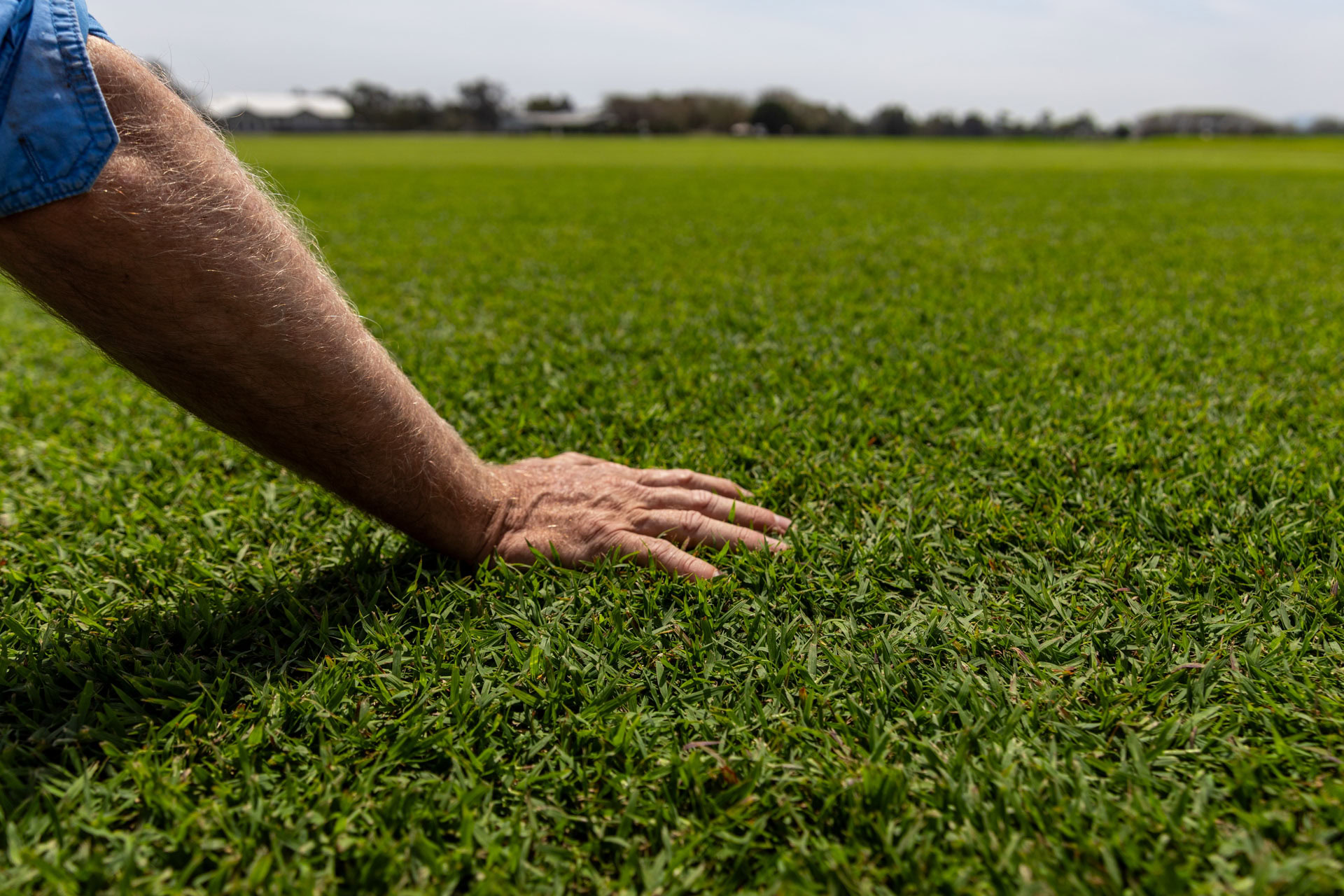
New lawns are not like an average lawn that’s been growing happily for years. They have been through the ringer…cut, stacked on pallets, transported from the farm, laid in a new environment and suddenly have less root structure to depend upon for growth. A newly laid lawn is in shock and you can’t blame it for needing all the help it can get.
That’s why at West Turf we recommend a quality lawn starter fertiliser with added water crystals to give your new lawn a boost in its time of need.
What newly laid turf needs – the basics
- Its roots to grow as fast as possible after being “cut” in the harvest process.
- Lots of water to save it from drying out
- A 75-100mm deep healthy soil to provide essential nutrients
- A little extra help recovering from the stress of transplant. That’s where lawn starter fertilisers come into action.
Fertilisers explained
Each lawn fertiliser comes with three macro-nutrients: Nitrogen (N), Phosphorous (P), Potassium (K). Here’s what they do:
| Nitrogen (N) | Nitrogen (N) Phosphorus (P) | Potassium (K) |
|---|---|---|
| Promotes leaf growth, chlorophyll production and greening. | Phosphorus (P) Supports robust and healthy root development. | Boosts overall strength and health of your turf. It will give it the energy to cope with dry spells, daily wear and disease. |
N-P-K is a ratio shown as three numbers on the fertiliser bag and represents the percentage of each nutrient in the fertiliser.
When and why and how to use lawn starter fertiliser
Lawn starter fertiliser is spread on top of the underturf soil at the prep stage (under the slabs of turf). It is a gentle mix of nutrients that nutures the new turf along as it establishes. Always follow the directions provided by the manufacturer and adhere to the application rates spreading as evenly as possible across the soil.
What’s in lawn starter fertiliser?
There are deliberate differences in NPK formula of lawn starter fertiliser compared to general all-purpose fertiliser mixes.
The best lawn starter fertilisers include:
- A higher level of phosphorus with a suitable phosphorus (P) to nitrogen (N) ratio compared to general all-purpose fertilisers, critical for promoting rapid root establishment in new grass, rather than just top leaf growth.
- A high potassium (K) amount and potassium (K) to nitrogen (N) ratio compared to general all-purpose fertilisers to help toughen the plant against insects, disease, and dry spells.
- Water crystals as a bonus additive that sit in the soil and draw up moisture when there is excess water and release it back into the soil for the lawn when the soil starts to dry out. This is well worth it when installing new turf in our South-East Queensland climate. Not all starter products include water crystals, and it’s worth hunting a product that does.
- Soil microbiology for overall plant and soil health.
The aim of lawn starter fertilisers is to develop strong, deep roots first, aid the plant’s resilience to stresses like heat, dry spells and disease and finally promote moderate leaf growth. It’s about getting the building blocks in place for a beautiful but tough established lawn.
Here’s how lawn starter fertiliser N-P-K ratios read compared to general all-purpose turf maintenance fertilisers:
| Lawn starter fertiliser for application on underturf soil BEFORE turf slabs are laid | General purpose fertiliser for broadcast over the top of established lawn |
|---|---|
| LawnPride Under Turf Starter NPK 10-8-5 | LawnPride Maintain NPK 26-1-9 |
| Lawn Play Underlay NPK 8-4-9 | Lawn Play All Rounder NPK 19-1-9 |
Note how the general-purpose fertilisers above have a much higher N (Nitrogen) component for pushing leaf growth and colour compared to the lawn starter fertilisers which concentrate on P (Phosphorous) and K (Postassium) to promote root growth and plant resilience.


Do you have to use lawn starter fertiliser?
Although it’s a recommended step in your turf install preparation, when it comes to the crunch, if you skip it, it’s not fatal for your lawn.
Without lawn starter fertiliser underneath the turf slabs, expect your turf to be slower establishing. The roots will be dependent upon the existing soil or underturf for nutrients. The new lawn will also rely on the water you give it for moisture without any backup from water crystals to protect against missing a session of watering.
The most important step in establishing new turf
Whether you apply starter fertiliser in the end is your decision, but one there’s one step in establishing new turf that is critical:
Watering.
Continue to water in subsequent weeks until your turf is well established, then water deeply, one to two times a week to encourage deep roots.
If you need more tips on turf prep go to our blog https://www.westturf.com.au/how-to-prepare-for-your-new-lawn/. Give us a call on 1300871366.